
News
Advancing Toward Commercialization
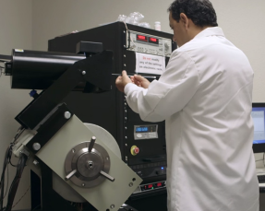
We are excited to announce that the AEC team, under the leadership of Mohsen Ahmadian, has been driving the commercialization of eight breakthrough technologies developed through our consortium’s collaborative research.
These innovations are the result of years of effort by our researchers and partners—from concept development and testing to refinement—and are now progressing toward real-world applications. Out of these eight, four priority technologies have been identified for rapid commercialization and market entry. The team is now working closely with industry partners to translate these advances into available commercial offerings.
To support adoption, our team has prepared detailed commercialization reports for each technology, which are available to AEC members. These reports provide critical insights into market opportunities, industry impact, technology readiness, and pathways for deployment. This is one of many unique benefits of AEC membership.
Together, AEC leadership and the teams' dedication are accelerating the path toward innovative and sustainable energy solutions.
Membership:
Join our community to gain access to cutting-edge research, intellectual property, and commercial-scale testing opportunities.
AEC-led Research and Sandia NL Reach Key Milestone in DOE-Funded Project with Smart Casing Collar Technology
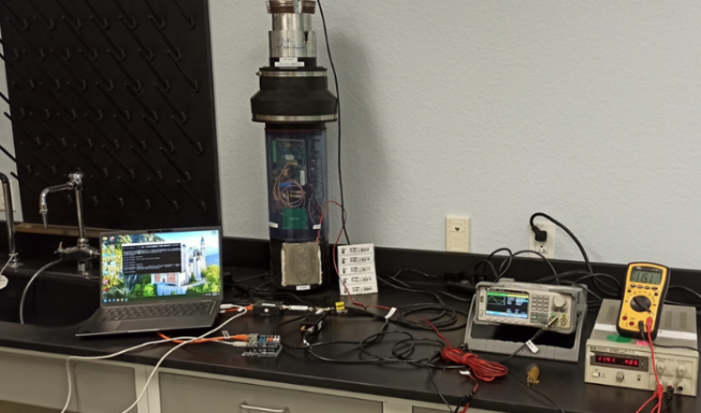
The Advanced Energy Consortium (AEC) at The University of Texas at Austin, the lead institution on this project, in collaboration with Sandia National Laboratories (SNL), has successfully demonstrated communication and powering of smart casing collars to support radiofrequency (RF) devices within a well-casing annulus.
This achievement marks a major milestone in the $3.7 million U.S. Department of Energy (DOE)-funded project led by Dr. Mohsen Ahmadian at UT Austin. Project partners also include the California Institute of Technology (Caltech) and the Research Triangle Institute (RTI).
At the technical core of the advance are sensor chips that can be wirelessly addressed and inductively powered through smart casing collars containing routers that communicate to the surface. “The collars complete an intelligent, integrated real-time monitoring system,” explained Dr. Ahmadian, emphasizing the significance of this step.
The breakthrough is the result of dedicated collaboration across the AEC/BEG research team, with critical contributions from Dr. Mahdi Haddad, Mr. Kemal Ozel, and Dr. Aaron Feng, who supported design, development, and system validation efforts.
This demonstration lays the foundation for a subsurface Internet of Things (IoT), advancing the deployment of autonomous wireless microsensors for real-time monitoring in diverse energy and environmental applications. Looking ahead, the team will focus on:
Testing cement integrity for carbon sequestration applications,
Enhancing RF sensors for long-term CO₂ monitoring,
Tracking pH, temperature, and methane under high-pressure, high-temperature well conditions.
Dr. Ahmadian’s leadership and the team’s technical expertise are shaping the future of intelligent subsurface monitoring and safe, sustainable energy solutions.
Major Breakthrough in Environmental Protection from UT Austin Researchers
A HUGE win for environmental protection!
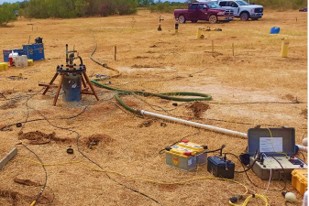
Researchers at the Advanced Energy Consortium (AEC), Bureau of Economic Geology at UT Austin, have achieved a major breakthrough in monitoring technology for detecting leaks in plugged and abandoned (P&A) wells. Funded by a combined $500K grant from the Ocean Energy Safety Institute (OESI) and AEC, this work opens the door to safer, more reliable long-term monitoring of P&A wells.
Project Leadership: The patent-pending novel SP/EM methodology was spearheaded by PI Dr. Mohsen Ahmadian and Co-PI Dr. Mahdi Haddad, leveraging commercial instruments from Zonge International to demonstrate the detection of EM/SP signals from engineered defective P&A wells at UT’s Devine Geophysical Test Site.
Team Contributions: The method was supported by AEC’s research team, who executed the field demonstrations and analysis. Their efforts highlight the power of collaborative, hands-on science in tackling urgent energy-environment challenges.
Collaborative Innovation: A novel numerical workflow, developed in partnership with Dr. Lindsey Heagy (University of British Columbia), integrated SP into EM modeling to deliver unprecedented accuracy in leak detection.
This non-invasive, remote monitoring approach makes it possible to surveil large numbers of wells efficiently—reducing environmental risks and simplifying long-term oversight.
A big thanks to all team members whose expertise made this possible—and a special acknowledgment to Dr. Raj Kota (OESI) for his continued support.
For more information, visit AEC: https://lnkd.in/gtzgSaUa or contact Mohsen Ahmadian.

